
By Haleema Ltd.
October 04, 2025
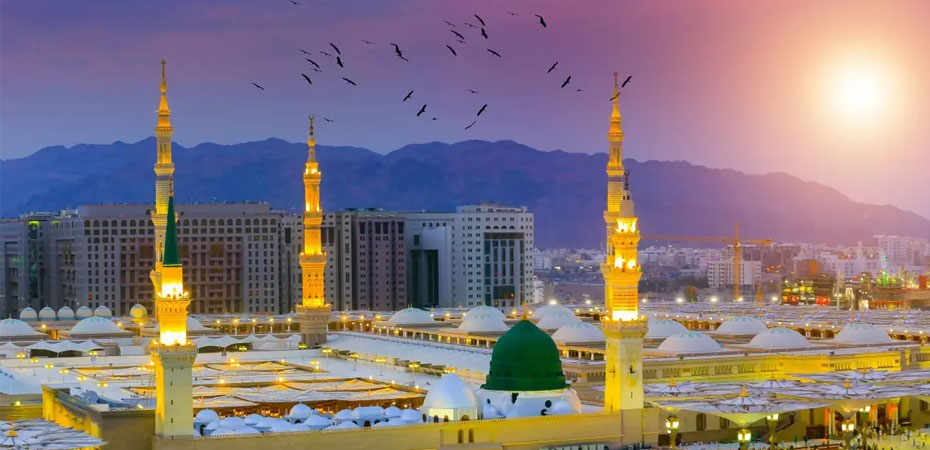
Al masjid an Nabawi (the Prophet's Mosque) - situated in the holy city of madina, Saudi Arabia, is among the most revered and sacred sites in islam. It ranks just after masjid Al haram in Mecca regarding holiness and spiritual importance. Starting from its humble origins in 622 CE to its present status as a magnificent architecture wonder attracting millions of worshippers each year, the history of Al masjid an Nabawi illustrates the development of the Islamic world and the lasting impact of the Prophet Muhammad (peace be upon him)
The foundation of the prophet's mosque
The mosque's beginnings are linked to the significant migration (hijrah) of Prophet Muhammad (PBUH) from Mecca to Yathrib which was later called Al-madina Al-Munawwarah (the Enlightened City). When he arrived in 622 CE - the Prophet (PBUH) looked for location where Muslims could gather for prayer, education, and communal activities The selected land belonged to two orphaned siblings, Sahal and Suhayl. Although it was first presented as a gift, the Prophet insisted on acquiring the property to guarantee that the establishment of the mosque was rooted in justice and equity. The area that was once utilised for drying dates and as a partial burial site was cleared and leveled with help from the prophet and his companions. The original structure was modest - approximately 30 × 35 meters in size. The walls were constructed from mud bricks, and the roof consisted of palm trunks and fronds. The ground was unpaved soil. There were three entrances, and the mosque included a shaded section called the "Suffah" where homeless and impoverished Muslims seek refuge and receive direct instruction from the prophet
Multipurpose functions of the early mosque
Al masjid an-Nabawi served a purpose beyond just being a place for prayers. It was the core of the early Islamic community, acting as a tribunal, a center for diplomacy, a hub for education and a refuge for the less fortunate. Here, the Prophet Muhammad (PBUH) gave sermons, conducted prayers, made significant political choices and welcomed delegations from various tribes’ and nations. The Qibla - which is the direction Muslims turn to during prayer, was first directed towards Jerusalem but was subsequently divinely altered to face the kaaba in Mecca while the prophet was praying in this mosque. This shift represented the spiritual and theological autonomy of Islam
Expansions and enhancements throughout history
With the swift expansion of Islam and increase in medina's population, the mosque underwent several expansions and renovations: Era of the Rashidun Caliphate Caliph Umar ibn al-Khattab (RA) and subsequently Caliph Uthman ibn Affan (RA) enlarged the mosque to serve the growing number of worshippers’. They implemented architectural enhancements - featuring stone walls and a wooden roof held up by columns Umayyad and Abbasid Caliphates During the Umayyad period - especially under Caliph al-Walid I - the mosque experienced its greatest expansion. At this point - the burial place of the Prophet Muhammad (PBUH) was for the first time surrounded by the mosque's walls, signifying the start of the site's holy atmosphere. Stunning Islamic art, featuring calligraphy and mosaics, started to emerge. The mosque's beauty and size were further enhanced by Abbasids, who further raised its reputation as a symbol of Islamic education and construction. Ottoman contributions In addition to performing substantial restorations, the Ottoman left behind the number of enduring elements, such as the Green Dome over the prophet's tomb - which is today well recognized as Al-Masjid an-Nabawi. During this period, mosque was enhanced with domes and minarets, and the interior featured Ottoman calligraphy and complex tile designs
Modern expansion under the kingdom of Saudi Arabia
The creation of the kingdom of Saudi Arabia in the 20th century marked a new era of modernisation and significant growth of al masjid an-Nabawi. King Abdulaziz ibn Saud (1932-1953) He started contemporary building methods while maintaining the mosque's original holy spaces. Electricity and illumination systems were implemented King Fahd's expansion (1985 to 1994) This stage almost doubled the mosque's size. expansive marble plazas, elevators, subterranean prayer rooms, and canopied shades were introduced. The cooling and audio systems were some of the most sophisticated globally
King Abdullah and king Salman expansions
Additional improvements comprised the enlargement of the northern courtyards and enhanced amenities for pilgrims, including more ablution spaces, relaxation areas, and information services for tourists. currently, the mosque has the capacity to hold more than a million attendees Vision 2030 The latest developments align with Saudi Arabia's vision 2030 - which seeks to transform Medina into a smart sustainable city for religion and culture. Improved security systems, smart crowd management, and cohesive transportation networks. Continuous upgrades to technological infrastructure, encompassing applications for Rawdah reservations and visitor assistance
Spiritual importance in Islam
Al masjid an-Nabawi is highly esteemed by Muslims worldwide. The messenger Muhammed (PBUH) stated: "One prayer offered in my mosque is better than a thousand prayers performed elsewhere, except for Al-Masjid al-Haram." (bukhari & Muslims) The mosque houses Al-Rawadah al-Sharifah (The Noble Garden), the area located between the prophet's grave and his pulpit (Minbar). It is said that praying in Rawdah resembles praying in a paradise garden. This Holy side attracts millions of devotees each year in search of blessings, tranquility, and proximity to the Prophet
The resting place of the prophet and his companions
Inside the mosque rests the revered tomb of Prophet Muhammad (PBUH) - together with the first two caliphs, Abu bakar Al-siddiq and Umar ibn al-Khattab. The room is humble, mirroring the straightforward lifestyle of the prophet. Though modest in nature, the site commands great respect, and people frequently express peace and blessings upon the prophet from this location Al-masjid an-Nabawi today: A global spiritual hub Currently, Al-Masjid an-Nabawi the same less represents a seamless combination of heritage and modernity. The mosque functions with advanced technology featuring climate regulation, security systems, multilingual signs and accessibility options for elderly and disabled attendees. It continues to be a peaceful gathering place for Muslims of all races and cultures who are bound together by their shared faith. The message of Islam - mercy, compassion and community - is embodied in the sense of fraternity and world solidarity that permeates its walls.
Prospective viewpoint
Looking ahead - Al-Masjid an-Nabawi is crucial to Saudi Arabia's strategy to accommodate 30 million pilgrims each year by 2030. Future projects consist of:
- Smart hajj system for managing crowd flow and tracking pilgrims
- Eco friendly design improvements for energy and water savings
- Improved visitor services, including multilingual AI assistants and mobile support applications Through a combination of tradition and modernity, the mosque is being meticulously readied to benefit future generations while preserving its sacred legacy
Conclusion
Al-Masjid an-Nabawi is not just an architectural wonder - it represents a vibrant heritage of Islam. Starting as a modest mudbrick building - it has evolved into one of the world's largest and most frequented religious sites, reflecting the ascent of a faith that transformed history. It still fulfills its initial purpose as a site for worship, education and togetherness. For Muslims - a trip to the prophet's mosque is a spiritually enlightening experience, a return to the foundation of Islam, and a reminder of the enduring message of peace, justice, and faith that the Prophet Muhammad (PBUH) conveyed. With its current splendor and tranquility, Al-Masjid an-Nabawi is still a place of contemplation and calm, a lighthouse that continues to lead millions of Muslims of people to faith and morality.